
Storage and retrieval machines: surviving in a niche market.
- Article
- Author: Hans Jürgen Jüngling
Storage and retrieval machine or shuttle? This question is one that the intralogistics industry is constantly grappling with. Despite the ongoing shuttle boom, storage and retrieval machines are holding their own. Most providers of warehouse solutions continue to rely on both technologies. There are even cases where they combine the two to achieve maximum efficiency in storage and retrieval.
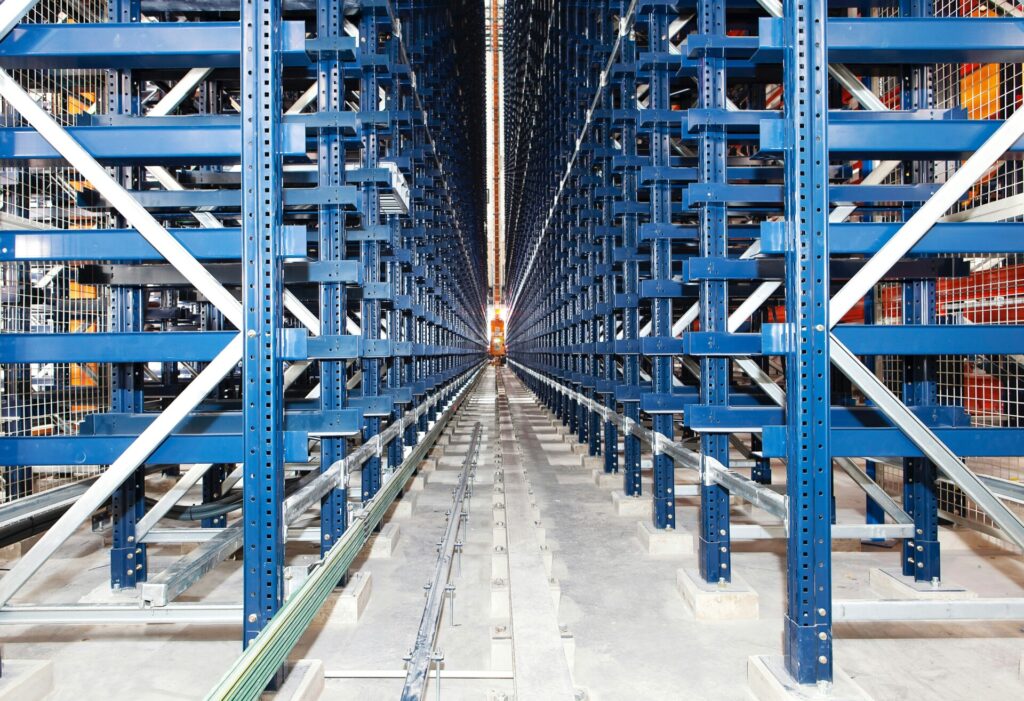
They have often been declared dead. We are talking about storage and retrieval machines, which perform their work reliably on rails as single or double masts mounted on a chassis in an aisle between two rows of shelves. In order to pick up, deliver and return their load, they move in multiple dimensions – lengthwise, heightwise and depthwise. A crucial element in the performance of a storage and retrieval machine is the configuration of the load handling device.
Storage and retrieval machines were invented more than 60 years ago. Since then, they have proven themselves in the field of automated pallet and small parts handling, not least thanks to their durability and robustness. But now they are coming under increasing pressure from the shuttle. Its triumph is closely linked to online shopping, including ‘try before you buy’. The requirements for warehouse logistics associated with e-commerce and omnichannel distribution – in addition to high order frequencies, above all the fast response times promised by many retail companies – can usually be better implemented with the help of shuttle technology. The trend towards decentralised warehouses is also contributing to the further spread of shuttles.
Compared to the much more modern alternative, storage and retrieval machines are considered less flexible and more expensive because they require more installation space and place higher demands on statics and floor construction. Further compromises arise in terms of scalability. In addition, storage and retrieval machines are said to be less energy-efficient than their new competitors. In times when energy is a scarce and expensive commodity, this argument carries considerable weight. Measures such as lightweight construction, energy-saving drives, energy recovery and continuously improved driving dynamics repeatedly compensate for this shortcoming. Storage and retrieval machines have now reached a technical level that is almost impossible to surpass, which limits their further development.
Nevertheless, storage and retrieval machines can still score points in numerous application scenarios. These include systems in which a high storage density is achieved vertically on a small footprint. The fact that a storage and retrieval machine can be used at heights of up to 45 metres is a significant advantage. In general, the industry principle is that storage and retrieval machines are more suitable for systems with lower throughput and high storage capacity. In addition, experts largely agree that storage and retrieval machines will find a secure niche in the heavy-duty sector in the long term.
It is not uncommon to find systems in which storage and retrieval machines and shuttles complement each other perfectly. In one such application, for example, the storage and retrieval machine transports the pallets from the entry and exit positions of the warehouse to the respective storage channel. There, a shuttle takes over the pallets and transports them from the storage and retrieval machine’s carriage into the channel. The combination of both systems thus creates an advantageous solution for requirements that lie in the border area between shuttles and storage and retrieval machines.
LOGISTICS & AUTOMATION 2026 offers an ideal platform for learning about the latest innovations and developments in the field of storage and retrieval machines. Intralogistics experts will present state-of-the-art technologies, best practices and efficient automation solutions that help companies design their warehouse processes to be precise and future-proof.
Save the date: LOGISTICS & AUTOMATION 2026 – your gateway to high-performance warehouse technology!